Iraq 2026
Iraq 2027
Please check back January 2027 for further updates
Iraq (April 25-May 04, 2026)
Join us for a journey through Iraq, the heartland of the former Abbasid Empire. We will visit historical sites from various eras of Iraq’s history (pre-Islamic & early Islamic times all the way to the Saddam era) as well as places of religious significance to pre-Islamic paganism, Christianity and Islam. The main trip will begin in the southern Persian Gulf city of Basra and end in the northern Kurdish city of Erbil. We will see architectural wonders, cultural gatherings, religious sites and ancient marketplaces. We will get a taste of the exquisite Iraqi cuisine and most of all, experience the wonderful hospitality of a cultured & welcoming people.
Itinerary
Arrival to Basra
For those arriving by early evening, we will stroll in the Corniche and take a ride in the Shatt al-Arab river with traditional Ashari boats (not the creedal Ashari!).
The Basra airport typically connects to key transit hubs (Doha, Dubai, Istanbul and Amman).
Basra
We will start with a walk around old Basra and then take a bus ride to the neighboring town of Al Zubayr which was the historic Basra of the early Islamic period and the region where the infamous Battle of the Camel occurred between the forces of the Prophet’s wife Aisha (d. 58AH/ 678 CE) and cousin Ali ibn Abi Talib (d. 40 AH/ 661 CE). There we will visit the attributed graves of several Muslim sages including Hasan al-Basri (d. 110 AH/728 CE), Muhammad ibn Sirin (d. 110AH/728 CE) and most important of all, the senior Companion of the Prophet, Zubayr ibn al-Awwam (d. 36 AH/656 AH), who was martyred in the aforementioned Battle.
We will proceed to Chibayish, a town by the Euphrates, and have a special river-fish meal in the Al Mudhif reed houses. We will explore by boat the floating villages along the Marshes, which is a UNESCO world heritage site (and one of the largest ecosystems in the world – just be sure not to pet the water buffalos!), where the people of Ahwar/Al Madan dwell, giving us a glimpse into a traditional lifestyle that has existed for centuries on end.
The day’s journey will end in the city of Nasiriyah, where we will retire for the night.
Journey to Najaf
Our morning bus journey will have its first stop at the historical city of Ur to visit the Great Ziggurat (another UNESCO world heritage site), which was the former capital of Mesopotamia during Sumerian times. Here we will see the Sholgi palace, the oldest arch of its kind at the entrance of the Dub-Lal-Makh temple, and visit a house attributed to Prophet Abraham.
We will then proceed to another ancient Mesopotamian city, Uruk, where writing is said to have originated around 3300 BC. This ancient city was the home of the legendary king Gilgamesh who ruled in the 27th century BC and is the hero in the timeless literary classic, The Epic of Gilgamesh.
We will end the day in Najaf and visit the shrine complex of Imam Ali (d. 40 AH/661 CE), the 4th Caliph of Islam and a key figure in both Sunnism and Shiism (as the 1st Shiite Imam). Travelers will also have an opportunity to shop in the Najaf Grand Bazaar.
Karbala
We will begin the day in the neighborhood of Kufa, which was one of the four most important cities in early Islam (alongside Mecca, Medina and Damascus). We will visit a house reportedly belonging to the Caliph Ali, then tour the Grand Mosque of Kufa where seminal figures of Islam –like Imam Abu Hanifa (d. 150 AH/767 CE) – taught. We will pass through an area where Sunni historical sources believe Imam Ali was buried. Finally, before heading to Karbala, we will stop to take in the mesmerizing view of the world’s largest cemetery, Wadi-us-Salaam.
In Karbala, we will tour the “Memory of Islam” museum and then proceed to the shrine complex of the Prophet’s grandson Imam Hussein (d. 61 AH/680 CE) and his half-brother Abbas (d. 61 AH/680 CE), a place that welcomes millions of pilgrims every year. We will end the evening dining on local food and sweets.
Babylon
Our exciting day will begin with a tour of the al-Ukhaidir Palace Fortress, which was built by Isa ibn Musa (d. c. 167 AH/784 CE), the former governor of Kufa and nephew of the first two Abbasid caliphs.
Iraq is not just a historical region for Islam but also for Christianity - to see this up close we will visit the al-Aqaiser Church, the oldest in Iraq.
Finally, we will visit remnants of the ancient city of Babylon, a UNESCO world heritage site and key location in the Western historical mind. There we will walk through the rebuilt Ishtar gate, old temples, palace mazes and the reported death location of Alexander the Great (d. 323 BC).
The journey will end in Baghdad where we will have a light stroll through a shopping mall and experience the evening vibes of a modern neighborhood of the city.
“Madinat al-Salam”: Baghdad
Baghdad, the former capital of the Islamic world, was founded by the second Abbasid caliph, al-Mansur (d. 158 AH/775 CE), and is the capital city of the nation state of Iraq.
While the previous evening was dedicated to modern Baghdad, we will dedicate this day to Old Baghdad starting with a tour of Al Rasheed street, visiting the copper market ‘Al-Safafeer’, the stationary market ‘Souq al-Sarai’, antiques market ‘Khan al-Mudalal’, and finally, the famous book street, ‘Al-Mutannabi Street’, whose books remain unlocked and visible overnight (the ancient local belief is thieves do not steal books as they are not interested in learning!). The street is named after the acclaimed pre-modern Arab poet Abu al-Tayyib al-Mutanabbi (d. c. 359 AH/965 CE), whose verses are memorized across federal Iraq and who has become a modern cultural emblem of the country.
We will visit a memorial site for the founder of the fourth legal school of Sunni Islam, Imam Ahmad ibn Hanbal (d. 241 AH/855 CE) and the grave of his intellectual successor and polymath author, Ibn al-Jawzi (d. 597 AH/1201 CE).
The busy day will continue with lunch on Hayder Khana Street (don’t forget to get a treat from al-Shahbender café and fresh juice from Haj Zbala)! Along the way we will also pass through various statues depicting elements of the famed Arabian Nights tales as well as the Al-Shaheed Monument built in commemoration of Iraqi soldiers who died in the Iran-Iraq War (1980-1988 CE). The evening will conclude with watching a traditional Ghalghi performance at a heritage café.
Field trip to Wasit
We will leave Baghdad early in the morning and begin with a visit to the Arch of Ctesiphon (aka Taq Kasra) – the largest single-span vault of unreinforced brickwork in the world. Ctesiphon (or later called Salman Pak) was the royal capital of the Parthian and Sasanian empires. We will also see the attributed tomb of the Prophet’s Persian-convert Companion, Salman al-Farisi (d. c. 33AH/ 652 CE) and then journey on to Kut to see the Wasit Gate, which is believed to be a remnant of the Sharabai Quran school built by the powerful Umayyad general, Hajjaj ibn Yusuf al-Thaqafi (d. 95 AH/ 714 CE). Wasit (literally: “Middle”) was built by Hajjaj and is called so because it was a garrison town strategically in the middle of Basra and Kufa. We will end the day with some modern history by touring the battle site of the Siege of Kut, where during World War I Ottoman forces defeated the British Indian army.
Jumuah prayer will be at the Abu Hanifa mosque (where his shrine is). We will also see the tomb of the Hanbali ascetic Abdul Qadir Jilani (d. 561 AH/1165 CE) and the Kadhimiya shrine complex for the 7th Shiite Imam Musa al-Kadhim (d. 183 AH/799 CE) and the 9th Imam Muhammad al-Jawad (d. 220 AH/835 CE).
Samarra and Hatra
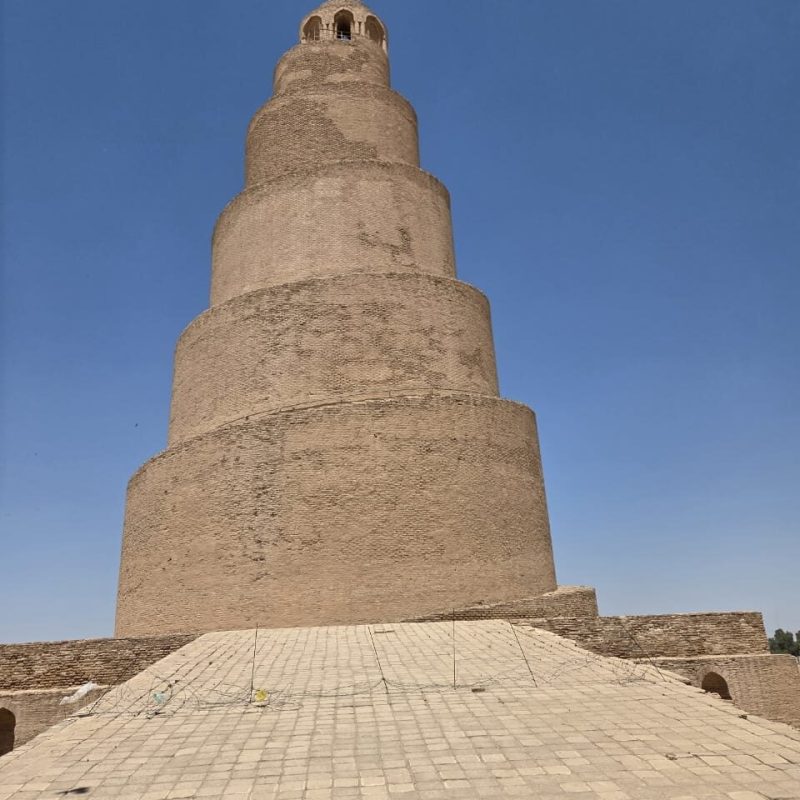
We will leave our beloved city of Baghdad and continue north to Samarra, the Abbasid city which served as the ancient capital for some decades and is a UNESCO world heritage site (much of it remains to be excavated). Here we will see the abandoned Abu Dulaf Mosque, built by the Abbasid caliph al-Mutawakkil in c. 245 AH/859 CE (Abu Dulaf is said to have been a famous soldier) as well as the earlier Jami Samarra al-Kabir mosque (which was the largest in the world at the time of its inauguration in 236 AH/851 CE, but was later destroyed by the Mongols in 656 AH/1258 CE). Both are known for their spiral Malwiya minarets. We will then see Kasa al-Khalifa (also known as the Samarra Water Palace- you’ll learn why they called it that during the tour – hint: dolphins!), which was built by the Abbasid caliph al-Mutasim in 221 AH/836 CE.
We will then proceed to the neighboring Askari shrine complex where the 10th Shiite Imam Ali al-Hadi (d. 254 AH/868 CE) and his son, the 11th Imam Hasan al-Askari (d. 260 AH/ 874 CE), are buried.
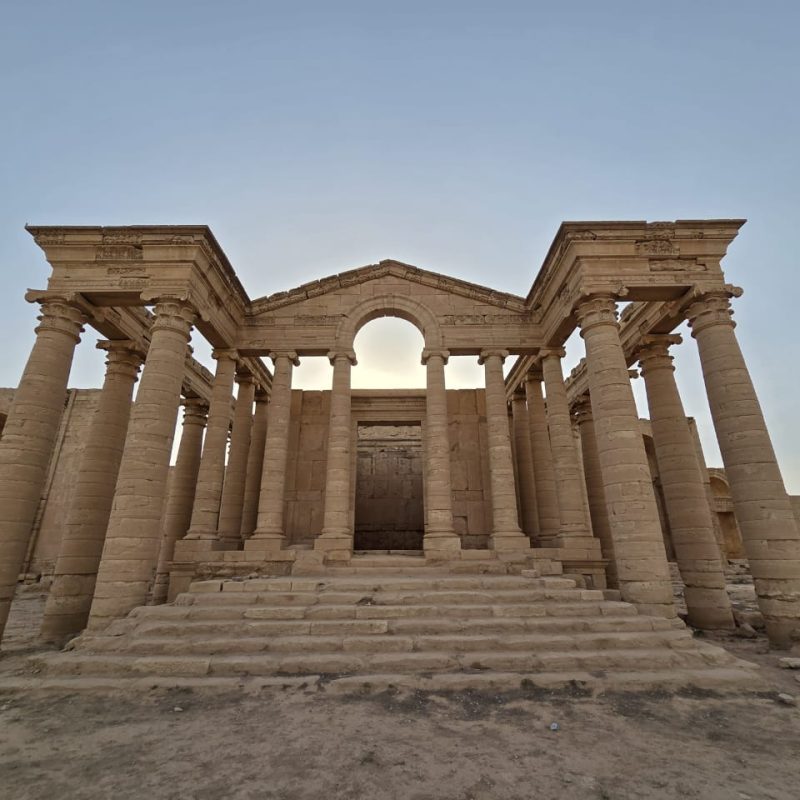
Next up will be a trip to Hatra (we will stop for lunch in a village) which was one of the first Arab states to be established outside of Arabia and an important historic and religious center with strategic positioning along caravan trade routes. We will see a few temples at this archaeological site including the Temple of Lat (an idol condemned in the Quran).
Finally, we will retire for the evening in Mosul and make sure we have the famous Lahm Baajeen dish before going to bed!
Mosul
We will tour the old city including al-Nuri mosque, al-Hadbaa minaret and al-Tahira church, all of which were partially destroyed during the ISIS control of the city a decade ago and are in the midst of being re-built with support from UNESCO. We will also walk through a neighborhood which was heavily bombed and still to be rebuilt all these years later. Next will be a drive to Lalish, the most holy land of the Yazidis. The trip will come to an end with our arrival in the Kurdistan capital of Erbil where we will have an evening tour of the Erbil Citadel, which is considered the longest occupied citadel in world history (continuing until today), along with a stroll through the lively Bazaar surrounding it.
Departure from Iraq (via Erbil)
It was a pleasure sharing the journey with you all! We will have access to the hotel until 12PM. Most of the international flights should be able to get you back to the US on the same date in time to be at work on Tuesday.
Packages
Please note, we selected hotels as compatible to Western travelers as possible while taking into consideration proximity for our itinerary as well as noting that smaller cities have fewer options compared to larger cities.
Addons:
If you wish to have a private room, there is an additional fee of: $950 USD.
Included
- Tourism Site Tickets
- 9 Nights at 3-, 4-or 5-Star Hotels(2 beds, i.e. you will have a roommate of the same gender)
- 2 Daily Meals (breakfast and lunch OR dinner)
- Airport Shuttle and Local Guides.
Does NOT include
International airfare (travelers are to book their own flights) – if you’d like some guidance regarding flight options, please feel free to reach out to us before you purchase the tickets. Also, does NOT include hotel incidentals, medical treatment, additional meals and the e-VISA (which can be obtained via an online application and is usually processed within a few business days of submission).
Initial registration requires a non-refundable deposit of $150. Full payment is due by March 31, 2026.
Gallery
Shahyad Tower
Iran

Duration
1Week

Difficulty
Easy

Min Age
18
Frequently Asked Questions
The heart of the tour is all about seeing numerous historical sites, which will involve extensive walking. While we cannot give an exact number, it wouldn’t hurt to be prepared to walk about 10,000 steps a day. Some energetic travelers could use their time to explore every inch of a site whereas other travelers may take a slow stroll with frequent breaks.
While a hijab is not required in most of Iraq- aside from the shrine complexes- it would be advisable for women to wear modest clothing (e.g. no short skirts or tank tops). Western attire is quite normal.
Federal Iraqis speak Arabic and Kurds speak Kurdish. Most of our trip will be in Federal Iraq. Our tour guides speak English. Many younger educated Iraqis likely speak English as well. It does not hurt to have Google Translate or another app handy in case you decide to go on an evening shopping spree after the daily itinerary is complete.
We will have opportunities to convert Euros or US Dollars to the Iraqi Dinar. For larger transactions (say buying a fancy carpet), vendors may prefer your Western currency.
As long as there is no sign prohibiting pictures (which may be placed at sensitive locations such as government facilities), sure! However, as obvious as this sounds, please seek consent before photographing any individuals (especially a police or military officer, or a woman in religious attire).
The Iraqi people are very welcoming and love hosting foreign tourists. They are particularly used to European travelers and are up to date with American culture (music, Hollywood, you name it).
No, everyone is welcome! Given most of our destinations tend to be Muslim-oriented, we will provide a cultural overview of what to expect for non-Muslim travelers to help facilitate a pleasant experience (and will provide a burqa for the shrine visits).
Iraq is a Muslim country with plenty of mosques. We will have a brief period arranged each day to pray Zuhr/Asr (combined) as a group. For Maghrib/Isha, travelers may pray it combined in the hotel.
Obtaining a visa is a rather seamless process for most Western passport holders – the application can be done entirely online (https://evisa.iq/en). It costs about $150 for US citizens. If your citizenship is not eligible for an e-visa, please contact us if you would like guidance on submitting the paper application.
The weather varies as we travel north through the country but we expect it to range on average from 70 to 90 Fahrenheit (21 to 32 Celsius).
It depends on what you want to buy and on your budget. Some people want something grand like a fancy antique and others just want local souvenirs here and there. A typical meal may cost anywhere between $4 to $12. Also keep in mind there will be a transaction fee to use the ATMs so it is best to have cash on hand (credit cards work in shopping malls and the like).
Yes, the hotels have wifi. In terms of network coverage outside the hotels, you will have to check with your Western phone network provider.
If there’s a particular spot someone is determined to see (perhaps a childhood home of theirs) and it falls within our itinerary geography, please let us know as early as possible and we can discuss if it is feasible to arrange it.
While modern Iraqi history may give this impression, there is no visible strife that a tourist will notice during the trip. While the southern half of the country is mostly Shiite and the northern half mostly Sunni, it is normal for either/or to be roaming around without issue. There can be some slight cultural tensions between Federal Iraqi Arabs and the Kurds in Kurdistan but it is quite subtle and hard for a foreigner to detect.
You’ll find typical supermarkets and other stores in the cities. If there’s anything in particular you need while there, just let us know and we’ll help you find it.
Iraq 2026
Join us for a journey through Iraq, the heartland of the former Abbasid Empire. We will visit historical sites from various eras of Iraq’s history (pre-Islamic & early Islamic times all the way to the Saddam era) as well as places of religious significance to pre-Islamic paganism, Christianity and Islam. Travelers will start the trip flying into the southern Persian Gulf city of Basra and end the trip flying out of Erbil, the northern Kurdish capital. We will see architectural wonders, cultural gatherings, religious sites and ancient marketplaces. We will get a taste of the exquisite Iraqi cuisine and most of all, experience the wonderful hospitality of a cultured & welcoming people.
The Basra airport services key transit hubs (Doha, Dubai, Istanbul and Amman) with select flight timings. We anticipate the vast majority of the flights to arrive by 10:00AM. Accordingly, we will begin the tour at 12PM.
We will start with a walk around old Basra, seeing the phenomenal Shanasheel-themed houses as well as the Ashar Canal, visiting the Old Basra Bazar, and grabbing some Iraqi shawarmas while we’re at it! Next will take a bus ride to the neighboring town of Al Zubayr which was the historic Basra of the early Islamic period and the region where the infamous Battle of the Camel occurred between the forces of the Prophet’s wife Aisha (d. 58AH/ 678 CE) and cousin Ali ibn Abi Talib (d. 40 AH/ 661 CE). There we will visit the attributed graves of several Muslim sages including Hasan al-Basri (d. 110 AH/728 CE), Muhammad ibn Sirin (d. 110AH/728 CE) and most important of all, the senior Companion of the Prophet, Zubayr ibn al-Awwam (d. 36 AH/656 AH), who was martyred in the aforementioned Battle. We will then check into our hotel for a break. The evening will include a ride in the Shatt al-Arab river with traditional Ashari boats (not the creedal Ashari!), a walk in the Corniche and a sea-food dinner.
Our last visit in Basra will be to the Cultural Museum which used to be a Presidential Palace of Saddam Hussein (d. 2006) – just one among his 80+ palaces (!).
We will then begin our road trip by driving to Qurna, the meeting point of the famous Tigris and Euphrates rivers, whose waters bore witness to the birth of several ancient civilizations. We’ll have a glimpse of the what’s called the Tree of Adam - an ancient jujube tree of knowledge referenced in the Bible.
Afterwards we will proceed to Chibayish, a town by the Euphrates, and have a special river-fish meal in the Al Mudhif reed houses. We will explore by boat the floating villages along the Marshes, which is a UNESCO world heritage site (and one of the largest ecosystems in the world – just be sure not to pet the water buffalos!), where the people of Ahwar/Al Madan dwell, giving us a glimpse into a traditional lifestyle that has existed for centuries on end.
The day’s journey will end in the city of Nasiriyah, where we will retire for the night.
Our morning bus journey will have its first stop at the historical city of Ur to visit the Great Ziggurat (another UNESCO world heritage site), which was the former capital of Mesopotamia during Sumerian times. Here we will see the Sholgi palace, the oldest arch of its kind at the entrance of the Dub-Lal-Makh temple, and visit a house attributed to Prophet Abraham.
We will then proceed to another ancient Mesopotamian city, Uruk, where writing is said to have originated around 3300 BC. This ancient city was the home of the legendary king Gilgamesh who ruled in the 27th century BC and is the hero in the timeless literary classic, The Epic of Gilgamesh.
We will end the day in Najaf and visit the shrine complex of Imam Ali (d. 40 AH/661 CE), the 4th Caliph of Islam and a key figure in both Sunnism and Shiism (as the 1st Shiite Imam). Travelers will also have an opportunity to shop in the Najaf Grand Bazaar.
Note: we will have a break for those interested in attending Friday prayer services.
We will begin the day in the neighborhood of Kufa, which was one of the four most important cities in early Islam (alongside Mecca, Medina and Damascus). We will visit a house reportedly belonging to the Caliph Ali, then tour the Grand Mosque of Kufa where seminal figures of Islam –like Imam Abu Hanifa (d. 150 AH/767 CE) – taught. We will pass through an area where Sunni historical sources believe Imam Ali was buried. Finally, before heading to Karbala, we will stop to take in the mesmerizing (and gloomy) view of the world’s largest cemetery, Wadi-us-Salaam.
In Karbala, we will tour the “Memory of Islam” museum and then proceed to the shrine complex of the Prophet’s grandson Imam Hussein (d. 61 AH/680 CE) and his half-brother Abbas (d. 61 AH/680 CE), a place that welcomes millions of pilgrims every year. We will end the evening dining on local food and sweets.
Our exciting day will begin with a tour of the al-Ukhaidir Palace Fortress, which was built by Isa ibn Musa (d. c. 167 AH/784 CE), the former governor of Kufa and nephew of the first two Abbasid caliphs.
Iraq is not just a historical region for Islam but also for Christianity - to see this up close we will visit the al-Aqaiser Church, the oldest in Iraq.
Finally, we will visit remnants of the ancient city of Babylon, a UNESCO world heritage site and key location in the Western historical mind. There we will walk through the rebuilt Ishtar gate, old temples, palace mazes and the reported death location of Alexander the Great (d. 323 BC).
The journey will end in Baghdad where we will have a light stroll through a shopping mall and experience the evening vibes of a modern neighborhood of the city.
Baghdad, the former capital of the Islamic world, was founded by the second Abbasid caliph, al-Mansur (d. 158 AH/775 CE), and is the capital city of the nation state of Iraq.
While the previous evening was dedicated to modern Baghdad, we will dedicate this day to Old Baghdad starting with a tour of Al Rasheed street, visiting the copper market ‘Al-Safafeer’, the stationary market ‘Souq al-Sarai’, antiques market ‘Khan al-Mudalal’, and finally, the famous book street, ‘Al-Mutannabi Street’, whose books remain unlocked and visible overnight (the ancient local belief is thieves do not steal books as they are not interested in learning!). The street is named after the acclaimed pre-modern Arab poet Abu al-Tayyib al-Mutanabbi (d. c. 359 AH/965 CE), whose verses are memorized across federal Iraq and who has become a modern cultural emblem of the country.
We will visit a memorial site for the founder of the fourth legal school of Sunni Islam, Imam Ahmad ibn Hanbal (d. 241 AH/855 CE) and the grave of his intellectual successor and polymath author, Ibn al-Jawzi (d. 597 AH/1201 CE).
The busy day will continue with a boat ride on the Tigris river and lunch on Hayder Khana Street (don’t forget to get a treat from al-Shahbender café and fresh juice from Haj Zbala)!
Along the way we will also pass through various statues depicting elements of the famed Arabian Nights tales as well as the Al-Shaheed Monument built in commemoration of Iraqi soldiers who died in the Iran-Iraq War (1980-1988 CE).
The evening will conclude with watching a traditional Ghalghi performance at a heritage café.
This will be a slightly lighter day with visits to the Abu Hanifa mosque (where his shrine is), the Umm al Qura mosque built by Saddam Hussein, the tomb of the Hanbali ascetic Abdul Qadir Jilani (d. 561 AH/1165 CE) and the Kadhimiya shrine complex for the 7th Shiite Imam Musa al-Kadhim (d. 183 AH/799 CE) and the 9th Imam Muhammad al-Jawad (d. 220 AH/835 CE). On to more modern times, we will see the Royal Iraqi Cemetery where King Faisal I (d. 1933 CE), the former monarch of Iraq, as well as other members of the royal family, are buried.
We will leave Baghdad for the day and begin with a visit to the Arch of Ctesiphon (aka Taq Kasra) – the largest single-span vault of unreinforced brickwork in the world. Ctesiphon (or later called Salman Pak) was the royal capital of the Parthian and Sasanian empires. We will also see the attributed tomb of the Prophet’s Persian-convert Companion, Salman al-Farisi (d. c. 33AH/ 652 CE) and then journey on to Kut to see the Wasit Gate, which is believed to be a remnant of the Sharabai Quran school built by the powerful Umayyad general, Hajjaj ibn Yusuf al-Thaqafi (d. 95 AH/ 714 CE). Wasit (literally: “Middle”) was built by Hajjaj and is called so because it was a garrison town strategically in the middle of Basra and Kufa. We will end the day with some modern history by touring the battle site of the Siege of Kut, where during World War I Ottoman forces defeated the British Indian army.
We will head back to Baghdad to retire for our final evening in the city.
We will leave our beloved city of Baghdad early in the morning and continue north to Samarra, the Abbasid city which served as the ancient capital for some decades and is a UNESCO world heritage site (much of it still remains to be excavated). Here we will see the abandoned Abu Dulaf Mosque, built by the Abbasid caliph al-Mutawakkil in c. 245 AH/859 CE (Abu Dulaf is said to have been a famous soldier) as well as the earlier Jami Samarra al-Kabir mosque (which was the largest in the world at the time of its inauguration in 236 AH/851 CE, but was later destroyed by the Mongols in 656 AH/1258 CE). Both are known for their spiral Malwiya minarets. We will then see Kasa al-Khalifa (also known as the Samarra Water Palace- you’ll learn why they called it that during the tour – hint: dolphins!), which was built by the Abbasid caliph al-Mutasim in 221 AH/836 CE.
We will then proceed to the neighboring Askari shrine complex where the 10th Shiite Imam Ali al-Hadi (d. 254 AH/868 CE) and his son, the 11th Imam Hasan al-Askari (d. 260 AH/ 874 CE), are buried.
Next up will be a trip to Hatra (we will stop for lunch in a village) which was one of the first Arab states to be established outside of Arabia and an important historic and religious center with strategic positioning along caravan trade routes. We will see a few temples at this archaeological site including the Temple of Lat (an idol condemned in the Quran).
Finally, we will continue on and retire for the evening in Mosul, and make sure we have the famous Lahm Baajeen dish before going to bed!
We will tour the old city including al-Nuri mosque, al-Hadbaa minaret and al-Tahira church, all of which were partially destroyed during the ISIS control of the city a decade ago and are in the midst of being re-built with support from UNESCO. We will also walk through a neighborhood which was heavily bombed and still to be rebuilt all these years later.
*There will be a break for an opportunity for Friday prayers at the Nabi Yunus mosque.
In the evening we will visit a café which used to be a war-time hospital during the ISIS control of the city.
We will have an early start heading to the Plains of Nineveh to have breakfast with a local Christian family in Bahzani and learn about their heritage and stories. They will then give us a tour of the Tahini factory of Bashiqa (we can have a free sample!) and take us on a visit to a temple.
Next will be Lalish, the most holy land of the Yazidis.
The trip will come to an end with our arrival in the Kurdistan capital of Erbil where we will have an evening tour of the Erbil Citadel, which is considered the longest occupied citadel in world history (continuing until today), along with a stroll through the lively Bazaar surrounding it.
It was a pleasure sharing the journey with you all! We will have access to the hotel until 12PM. Most of the international flights should be able to get you back to the US on the same date in time to be at work on Monday.
Additional Supplement
For travelers interested in staying in Iraq for a few extra days, we can arrange a tour of Sulaymaniyah, which is close to the Iranian border and has a unique culture of its own as well as fascinating mountain resorts. Please contact us for further details.
We hope to see you for our 2026 tours (Mali, Afghanistan and Nigeria) – Iraq tour alumni will receive a discount!
- The years listed above (in AH and CE) are approximations.
- This is a tentative itinerary which is subject to change at the discretion of local conditions as determined by the guides as well as the daily pace of the group.
- The inter-city travel across the country during the tour will be on an temperature controlled bus.
Packages
Includes tourism site tickets, 11 nights at 3, 4 or 5 star hotels* (2 beds, i.e. you will have a roommate of the same gender), 2 daily meals (breakfast and lunch OR dinner), airport shuttle and local guides.
- If you wish to have a private room, there is an additional fee of: $1150 USD.
- Please note, we selected hotels as compatible to Western travelers as possible while taking into consideration proximity for our itinerary as well as noting that smaller cities have fewer options (sometimes only one) compared to larger cities.
- Please contact us to confirm you qualify for the Graduate student and Senior citizen discount that will apply for the final trip invoice (registration page only requests a trip deposit).
Does NOT include
- International airfare (travelers are to book their own flights) – if you’d like some guidance regarding flight options, please feel free to reach out to us before you purchase the tickets
- Hotel incidentals
- Medical treatment
- Additional meals
- E-VISA (which can be obtained via an online application, and is usually processed within a few business days of submission).
If you wish to arrive on November 18th, please contact us to arrange for an additional hotel night (not part of package).
Initial registration requires a non-refundable deposit of $150. Full payment is due by October 19, 2025.
Gallery
Frequently Asked Questions
The heart of the tour is all about seeing numerous historical sites, which will involve extensive walking. While we cannot give an exact number, it wouldn’t hurt to be prepared to walk about 10,000 steps a day. Some energetic travelers could use their time to explore every inch of a site whereas other travelers may take a slow stroll with frequent breaks.
Obtaining a visa is a rather seamless process for most Western passport holders – the application can be done entirely online (https://evisa.iq/en). It costs about $150 for US citizens. If your citizenship is not eligible for an e-visa, please contact us if you would like guidance on submitting the paper application.
While a hijab is not required in most of Iraq- aside from the shrine complexes- (unlike in neighboring Iran), it would be advisable for women to wear modest clothing (e.g. no short skirts or tank tops). Western attire is quite normal there.
As we proceed north through the country, the weather will become more cooler. We suggest planning clothes for weather between 50-75 degrees Fahrenheit (10-24 Celsius).
Federal Iraqis speak Arabic and Kurds speak Kurdish. Most of our trip will be in Federal Iraq. Our tour guides speak English. Many younger educated Iraqis likely speak English as well. It does not hurt to have Google Translate or another app handy in case you decide to go on an evening shopping spree after the daily itinerary is complete.
It depends on what you want to buy and on your budget. Some people want something grand like a fancy antique and others just want local souvenirs here and there. A typical meal may cost anywhere between $4 to $12. Also keep in mind there will be a transaction fee to use the ATMs so it is best to have cash on hand (credit cards work in shopping malls and the like).
We will have opportunities to convert Euros or US Dollars to the Iraqi Dinar. For larger transactions (say buying a fancy carpet), vendors may actually prefer your Western currency.
Yes, the hotels have wifi. In terms of network coverage outside the hotels, you will have to check with your Western phone network provider.
As long as there is no sign prohibiting pictures (which may be placed at sensitive locations such as government facilities), sure! However, as obvious as this sounds, please seek consent before photographing any individuals (especially a police or military officer, or a woman in religious attire).
If there’s a particular spot someone is determined to see (perhaps a childhood home of theirs) and it falls within our itinerary geography, please let us know as early as possible and we can discuss if it is feasible to arrange it.
The Iraqi people are very welcoming and love hosting foreign tourists. They are particularly used to European travelers and are up to date with American culture (music, Hollywood, you name it).
While modern Iraqi history may give this impression, there is no visible strife that a tourist will notice during the trip. While the southern half of the country is mostly Shiite and the northern half mostly Sunni, it is normal for either/or to be roaming around without issue. There can be some slight cultural tensions between Federal Iraqi Arabs and the Kurds in Kurdistan but it is quite subtle and hard for a foreigner to detect.
You’ll find the expected supermarkets and other stores in the cities. If there’s anything in particular you need while there, just let us know and we’ll help you find it.
Iraq is a Muslim country with plenty of mosques. We will have a brief period arranged each day to pray Zuhr/Asr (combined) as a group. For Maghrib/Isha, travelers may pray it combined in the hotel (alternatively, if time permits and we are ahead of schedule, we can pray it as a group).
No, everyone is welcome! Given most of our destinations tend to be Muslim-oriented, we will provide a cultural overview of what to expect for non-Muslim travelers to help facilitate a pleasant experience (and will provide a burqa for the shrine visits).